Late last year, we set out to answer what seemed like a simple question: are social media download tools actually any good at preserving your digital life? Let’s just say we found quite a range of approaches.
After systematically benchmarking eight major platforms’ data export tools (including Instagram, Reddit, and recently-shuttered TypePad) we discovered that most were designed to tick regulatory compliance boxes rather than deliver genuinely preservation-ready archives.
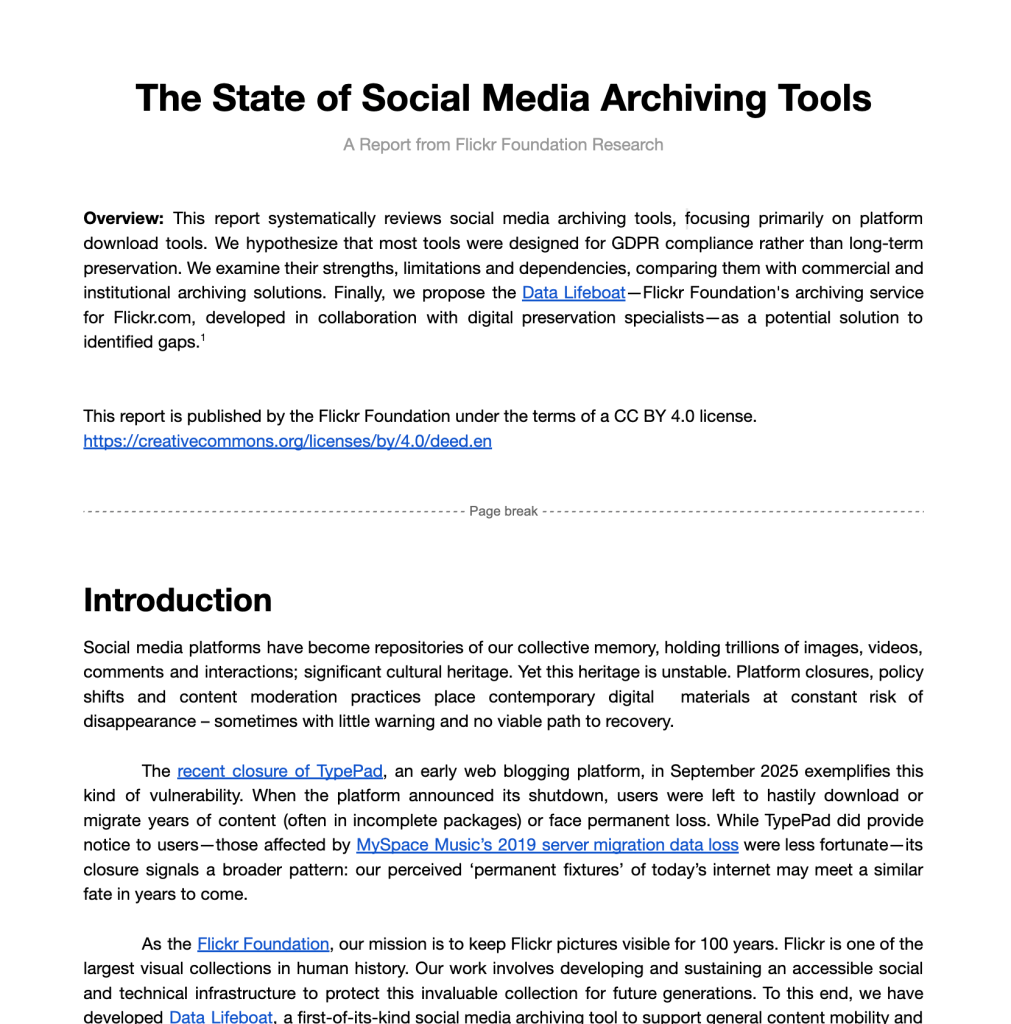
Read the Report
→ The State of Social Media Archiving Tools: A Report from Flickr Foundation Research (It’s a Google doc.)
What was our methodology?
We created dummy accounts, populated them with test content, clicked through every privacy setting maze, and systematically dissected the resulting download packages. We developed an assessment framework examining everything from user experience to archival readiness, also supplementing our dummy data with personal archives spanning years of actual platform use.
What you download is rarely quite what you uploaded: images get compressed, GIFs become MP4s, and we found that one platform mysteriously resets all dates to November 30th, 1979. The social bits—comments, collaborations, the relational threads that make social media actually social—get stripped away or scattered across “data archipelagos” where your metadata lives in one folder and your photos in another.
The findings reveal a two-tiered system where technically proficient people might be able to reproduce their digital archives while everyone else faces machine-readable JSON files and folder hierarchies that assume familiarity with command-line interfaces. Only Flickr Pro and one Tumblr option delivered unmodified original files—not great when you consider these tools are meant to give you your own stuff back.
Interesting isn’t it, when you combine these findings with Cory Doctorow’s Enshittification theory. What motivates a platform designed to lock you to provide an easy, effective escape hatch?
Data Lifeboat for Flickr?
As we developed our Data Lifeboat service in collaboration with institutional archivists and individual collectors who actually told us what they needed, we deliberately pushed past what we came to see as a “compliance-first approach.”
Data Lifeboat helps you collect others’ content with consent, preserves the full social context (comments, tags, groups), uses seed URLs for granular selection rather than all-or-nothing exports, and includes a collaborative free-text README so future archivists understand why this collection mattered. We made an archive called “That’s My Grandma!” to illustrate the point.
Explore the “found family” archive
Data Lifeboat is still young and far from perfect, but we hope it represents a shift from “here’s your data in a legally defensible format” to “here’s a meaningful archive you can actually use.” The gap between what regulations require and what preservation needs has been too wide for too long; we think we’ve built something that bridges it.
Please enjoy the report, released under CC BY 4.0: The State of Social Media Archiving Tools: A Report from Flickr Foundation Research