Elizabeth first came on our radar because of her work with It’s Nice That, a website showcasing creative culture and people who create. It’s fun, serious-yet-casual, and has some high caliber talent behind it. She also has her own newsletter, Casual Archivist, which showcases collections of things you might not such as magazine subscription cards or Christian missionary propaganda posters. She’s a knockout designer with an eye for ephemera and is also a Flickr fan.
I started with asking for a few images she pulled out of Flickr Commons just to use for article illustration and they’re scattered through this interview…

Joe’s Dope Sheet – VCU Libraries Commons
JW: Speaking of bookmarking, you seem to have a lot of different ways of casually archiving things online whether they’re sources or individual images. I’ve seen you use spreadsheets, Instagram, Are.na, Substack posts, your own website and probably other places I haven’t noticed. Do you view these mechanisms as ephemeral–used and then moved on from–or more additive–part of a general whole that is your online work? Do you have a curation flow that is specific, general, or more catch-as-catch can or tied to the moment?
Elizabeth Goodspeed: I have a lot of different collecting areas and interests, so I tend to use different tools for different kinds of collecting. Are.na is where I track what’s happening at this very moment—mostly contemporary design or art direction trends. I’d say it’s the closest thing I have to a “live radar” of how particular visual tropes are disseminating across the internet. (To your point about ephemerality: I used to use Pinterest for this kind of thing but switched to Are.na a few years ago since it’s a much more powerful tool, and, has no ads or annoying algorithmic suggestions!)

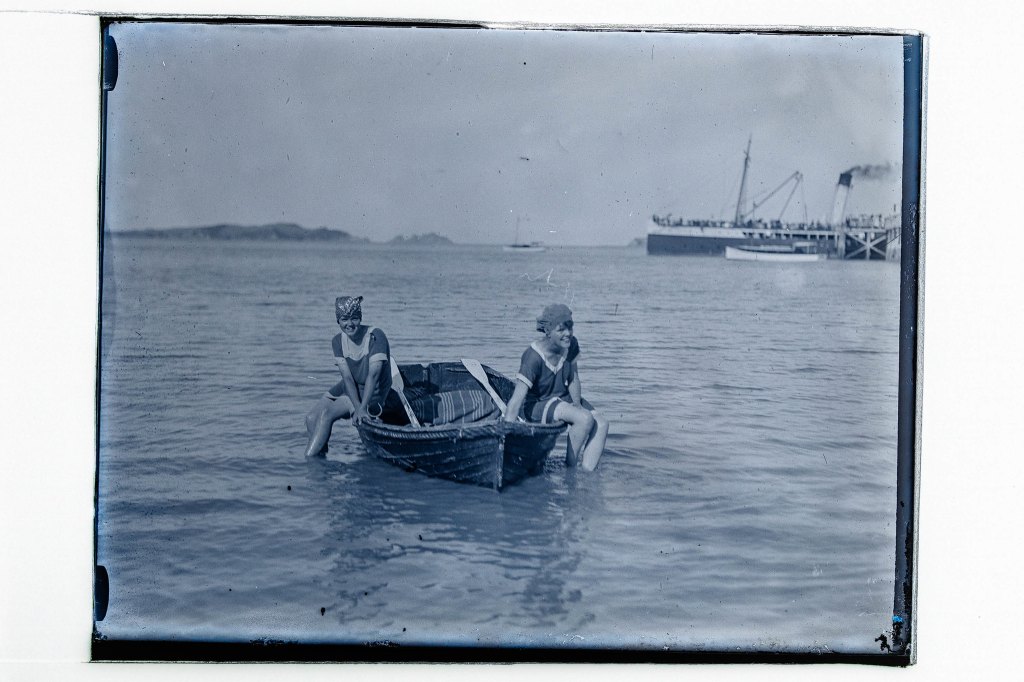
Picnic at Sherman’s Point, 1900. Camden Public Library
I also keep a handful of private boards there for client-specific research or inspiration. Instagram is more of a diary. It’s almost entirely things I’ve photographed myself (book covers at a flea market, old packaging, shop signs, etc.). In an ideal world I’d back it all up somewhere else, but I never quite get around to it! The stories are more for others than for me; I rarely scroll back through them unless I’m trying to remember something like the name of a book I picked up in a used bookstore and am now regretting not buying.

Victoria China Dinnerware, 1930. State Library of New South Wales
Google Drive is where the genuinely archival material lives—mostly high-res scans I’ve made myself. I also use it for historical imagery I find elsewhere (like Flickr) that I download at full resolution and organize by how I’d actually want to find it later, which means it sometimes duplicates what’s saved on other platforms. It’s probably redundant, but I’ve seen too many websites vanish—RIP FFFFOUND—so I’d rather keep the high-res material I know I’ll use somewhere I can navigate easily and trust not to disappear without warning.
It’s the most private layer too, since a lot of what I save there is meant for future client work or newsletters. It’s basically the dusty back room—less for display, more for safekeeping. Substack sits at the opposite end of that spectrum. It’s not an archive so much as a resource hub and place to share what I’ve found and frame it for others. It’s where the private collecting turns outward and becomes public, a way to make research communal instead of just another folder of references.

Uncle Bernie’s Glader Park beer can sign, Route 41, Coopertown, Florida – Library of Congress
To be honest, there’s no real “curation flow” I can easily point to for any of this! It all emerged pretty organically. I’m pretty type B and mostly save things impulsively—screenshots on my phone, links in a chat window, photos on my desktop—wherever is easiest at the time. Sometimes I’ll move them around later once I realize they suddenly fit into a project or pattern I’m thinking about and need them more thoughtfully organized. Mostly, I just like knowing the thing I wanted to save exists somewhere.
Overall, I think of all these platforms as additive—they each do something different and together form a kind of layered ecosystem. The websites I use themselves may be ephemeral, and come and go, but the act of collecting, saving, and revisiting things endures. Each time I move to a new platform, the habits and frameworks I’ve built move with me and the logic stays consistent: organize by how I’ll actually want to find something later, save what feels worth returning to, and leave room for chance rediscovery. I still revisit old folders and half-forgotten sites to see what I was collecting years ago or to trace how my own interests have evolved. It’s like sedimentary layers, where some get re-excavated and built upon, while others fossilize.
Once you handle original materials, you realize how flattened our digital understanding of “old stuff” has become.
JW: You’ve talked about how you canonically “care about old stuff” while also noting that one option for brands nowadays is to sometimes try to come up with a look that has some fake nostalgia to it. And yet fake nostalgia that sticks around long enough becomes real nostalgia. I may be reading too much into this or just noticing what appeals to me personally, but I think I see a bit of a preference towards retro in many of the looks you select, comment on, or design. Do you think this has always been your aesthetic? Or has what you’ve been interested in changed over time as your professional life has changed? Was there a turning point?
EG: I’ve always loved old stuff. Growing up, that was probably because it felt different and a little foreign—I thought old stuff was cool precisely because it wasn’t what was around me. It showed me that the world hadn’t always looked this way. That said, I don’t really believe in “timeless aesthetics,” and I don’t love old things out of sentimentality or some yearning for a “better time.” Mostly, I’ve grown to love how much they reveal about how culture organizes taste, and how meaning and values shift over time—and thereby also feel like a secret key in unlocking my own understanding of why the world right now also looks and acts the way it does. What interests me is the context—why something looked the way it did, who it was for, and what assumptions shaped it. So, my interest in the past is investigative, rather than nostalgic.

Estate map of the Pineapple Estate, Kangaroo Point, Brisbane, ca. 1890s – State Library of Queensland
The industry’s relationship to nostalgia has shifted a lot since I started working, though. When I was just beginning to get interested in historic design, I think, “vintage-inspired” design still felt like a mostly aesthetic decision (a way to zig when others were zagging). Now, I think it’s more of a strategy—a way to manufacture familiarity in a culture that doesn’t trust newness. Fake nostalgia becomes real nostalgia simply through repetition; the emotional reference gets recycled until it starts to feel earned. My relationship to that has evolved from fascination to skepticism. I still like using historical references, but I care more about what they mean than what they look like.
If there was a turning point, it probably came from working directly with archives. Once you handle original materials, you realize how flattened our digital understanding of “old stuff” has become. So much of what circulates online is decontextualized, filtered, or misattributed. Seeing the real thing—from the actual paper stock to the ink bleeds—has sharpened my eye for when nostalgia is being used lazily, without understanding what it’s referencing.
JW: Like yourself, I’m a sometimes-New Englander who works with people from the UK and am always interested in the subtle nuances, the little bits of style and differences between here and “Old England.” So this is a shorter question but as someone whose professional life is all about noticing the semiotics of stuff, and as someone who is a self-professed “word person” do you have any favorite little differences that you notice and like, or notice and like somewhat less?
[Pre-emptive disclaimer that absolutely nothing I’m about to say is about design or archives!]
One major thing I’ve noticed is that people in the UK love abbreviating things. It’s not quite at Australian slang levels (Australians literally have slang for slang—chock-a-block becomes chockers, etc.), but it’s not far off. A beverage is a “bevvie,” the lavatory is a “lav,” definitely becomes “defo.” I find this funny mostly because internationally, Americans are often accused of being informal and lacking class, and yet, we don’t have anything close to this kind of linguistic shorthand. Brits also love naming. Every cookie (sorry—biscuit) has a proper, agreed-upon non-brand name, as if there’s a national database where everyone decided what each thing should be called. Maybe someday I’ll finally learn what a Jaffa Cake is!

American Encaustic Tiling – VCU Libraries Commons
There’s definitely a deeper awareness of regional identity in the UK. People know exactly what an accent signals in terms of class, geography, and status (my total inability to pick up on those cues is apparently very entertaining). While I do love a regional accent—I have some relatives with great old-school Brooklyn ones—this is something that makes me appreciate the US. There’s more space to define yourself on your own terms here.
Overall, I probably get away with more than I should as an American working with Brits. Something about the combination of chipperness and perceived ineptitude seems to disarm people. I’m sure that goodwill has a shelf life, but for now, it’s working for me!
“…I worry about loss, but also about flattening. When images get detached from their original context, they start functioning as purely aesthetic material—or worse, as false history.”
JW: One of the missions of the Flickr Foundation is to help Flickr photos be available for 100 years. What are your thoughts, specific or general, about the challenges involved in digital preservation of sometimes-ephemeral content?
EG: I’m not an expert (see: casual archivist), but I’m well aware that digital preservation is always trickier than it seems. Files are easy to duplicate but hard to contextualize, and context is usually the first thing to disappear. A JPEG might survive a century, but its caption, tags, or the web of links that once surrounded it probably won’t. The internet gives this illusion of permanence, when in reality it’s more like a series of short overlapping windows. So I worry about loss, but also about flattening. When images get detached from their original context, they start functioning as purely aesthetic material—or worse, as false history. That risk feels especially relevant in the age of AI, when the difference between real and fabricated often comes down to what context survives.

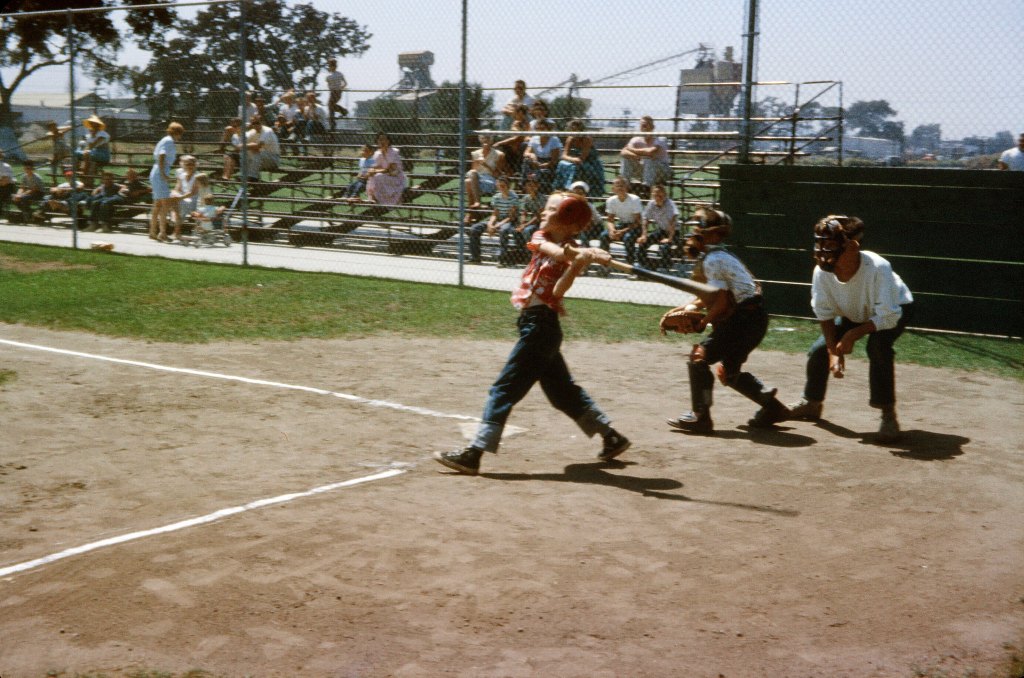
Synchronised Swimmers, 1970s. North East Museums
There’s also the question of what gets preserved. Archives inevitably reflect the priorities and resources of whoever maintains them. One thing I love about Flickr is how many people use it to save things that only they personally think are worth saving: old snack packaging, Black periodicals, terracotta bricks, French children’s books. That variation is both a strength and a weakness: it means certain unexpected things get documented, but it also means other things that might be equally important aren’t.
I think a lot about Marion Stokes and her obsessive TV taping. It was an individual effort that accidentally became a public record. At the time, her work probably seemed obsessive or trivial, but now much of it captures moments that no one else thought to save. With archiving, you rarely know what’s disposable and what might later prove significant, which is part of what makes archiving both necessary and impossible. Entire categories of imagery or creators can disappear simply because no one thought they mattered in the moment. That’s the tension between saving and hoarding. To complicate things further… formats change constantly, and there’s less on paper to begin with. One irony of digital preservation is that the files will probably outlast the software that can open them. So much of what we make today depends on proprietary systems that might not exist in a decade.
At the risk of being overly macabre, I think being an archivist is partly about accepting your own futile efforts and future demise. I’ve been to enough estate sales to know that you can spend your whole life assembling a collection only to have it dissolve and dissipate in an afternoon. I think everyone who does this kind of work knows that we are just a drop in the bucket. Speaking for myself, I save things for people in the future, but mostly, I save it for myself. Collecting is an art practice in its own right, a way of paying attention while I’m here. I hope some of it will last beyond a hundred years, but I’m also okay knowing it probably won’t.
Thank you Elizabeth for spending some time with us and sharing her process. People who want to follow Elizabeth’s work can find links to her projects and socials at ElizabethGoodspeed.com.